

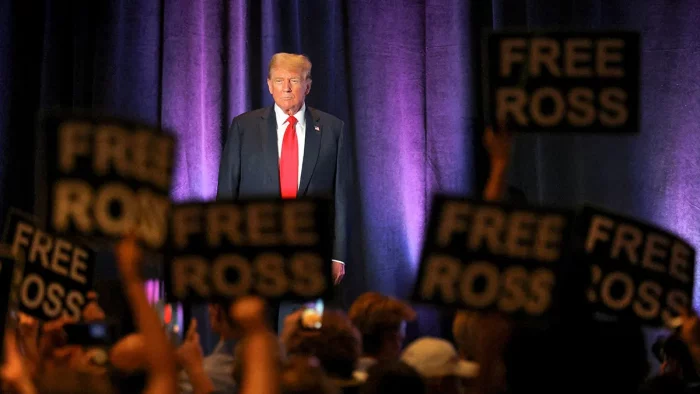
In a move that has ignited widespread debate across political, legal, and technological circles, former President Donald Trump has granted a full and unconditional pardon to Ross William Ulbricht, the founder of the notorious dark web marketplace, Silk Road. The announcement, made on Trump’s Truth Social platform, has sent shockwaves across the globe as it resurrects heated discussions about justice, ethics, and the future of digital innovation.
Ross Ulbricht, once operating under the alias “Dread Pirate Roberts,” created Silk Road in 2011. The platform was revolutionary, offering a marketplace where users could buy and sell goods anonymously using Bitcoin, a then-novel cryptocurrency. While touted by some as a groundbreaking experiment in free-market economics, Silk Road became infamous for facilitating the trade of illegal drugs, weapons, and other illicit goods, attracting nearly a million users worldwide. Approximately 30% of its user base hailed from the United States, highlighting the platform’s far-reaching influence.
Ulbricht’s double life came crashing down in October 2013 when he was arrested by the FBI in a San Francisco library. Investigators tracked him down through his email address, linking him to the creation and operation of Silk Road. In February 2015, a jury found him guilty of charges that included money laundering, computer hacking, and drug trafficking. Prosecutors accused him of contributing to at least six overdose deaths through the drug trade facilitated on his platform. At his sentencing, then-US Attorney Preet Bharara labeled him as “a drug dealer and criminal profiteer” and emphasized that his actions exploited vulnerable individuals while posing a significant threat to public safety.
The case against Ulbricht became a symbol of the government’s crackdown on the dark web and cybercrime. The Justice Department described Silk Road as “the most sophisticated and extensive criminal marketplace on the Internet today,” and his life sentence without the possibility of parole was seen as a stark warning to other potential dark web operators. However, the severity of the punishment sparked outrage among libertarians, privacy advocates, and supporters of digital freedom, who argued that the sentence was excessively harsh and politically motivated.
Trump’s pardon, announced in a characteristically dramatic fashion, came with a personal touch. “I just called the mother of Ross William Ulbricht to let her know that, in honor of her and the Libertarian Movement, which supported me so strongly, it was my pleasure to sign a full and unconditional pardon of her son, Ross,” Trump posted. He also described Ulbricht’s life sentence as “ridiculous” and accused the legal officials involved in the conviction of being part of a broader vendetta against him during his presidency.
The decision to pardon Ulbricht fulfills a promise Trump made during his 2024 campaign, particularly at the Libertarian Party’s national convention held in Washington, DC. At the event, he declared, “If you vote for me, on Day 1, I will commute the sentence of Ross Ulbricht to a sentence of time served. He’s already served 11 years. We’re going to get him home.” Trump’s alignment with the Libertarian Movement has been seen as a strategic move to consolidate support among a politically influential group known for advocating personal freedoms, smaller government, and justice reform.
The pardon has been met with mixed reactions. Libertarian National Committee Chair Angela McArdle praised the decision, describing Ulbricht as “a libertarian political prisoner for more than a decade.” She expressed relief that he would finally return home after years of what she and others view as unjust imprisonment. For libertarians and digital rights advocates, the pardon is a win for freedom, innovation, and a step toward addressing systemic issues in the justice system.
On the other hand, critics have expressed alarm, warning that the move undermines the rule of law and sets a dangerous precedent. Opponents argue that Ulbricht’s platform enabled widespread harm, particularly in drug trafficking, and that his conviction and life sentence were justified as a deterrent to others considering exploiting the anonymity of the dark web. Many legal experts have voiced concerns that the pardon could embolden cybercriminals and dark web operators, potentially leading to a resurgence in similar platforms.
Trump’s decision also raises questions about the influence of political ideologies on presidential clemency. By aligning himself with libertarian values, Trump has positioned himself as a champion of justice reform and a defender of personal freedom, moves that may bolster his political capital as he navigates the evolving political landscape.
This development has reignited global discussions about the ethics of dark web commerce, the role of cryptocurrency in illegal trade, and the balance between innovation and accountability. While Ulbricht’s supporters see him as a visionary who pushed the boundaries of digital technology, his detractors view him as a criminal whose actions had devastating real-world consequences.
The ripple effects of this decision are likely to extend far beyond Ulbricht’s case. It highlights the growing intersection between technology and law enforcement, the challenges of regulating anonymous online marketplaces, and the broader implications of presidential pardons on public trust in the justice system.
Trump’s pardon of Ross Ulbricht will undoubtedly remain a polarizing topic, sparking intense debates about justice, technology, and personal freedom for years to come.
Get the latest, most reliable, and engaging news and updates from Nigeria and beyond. Stay informed with expert analyses, breaking news, and stories that shape the world. Visit Trending Naija News today and subscribe to our newsletter for timely updates. Don’t miss out—be part of the conversation and stay ahead of the curve!
